Clogs that snaking usually handles well
- A single sink, tub or shower that has stopped draining
- A toilet that will not clear with a plunger
- Hair, soap and debris packed in a bathroom drain
- A floor drain or laundry standpipe that overflows
- A main sewer line stopped by wipes, paper or a root ball
- A drain that needs to be opened quickly before a deeper cleaning
Types of drain snakes and augers
"Snake" and "auger" are often used interchangeably. In practice the right tool depends on the size of the pipe and where the clog sits.
Hand augers
Small augers with a thin cable work well for bathroom sinks, tub and shower drains, and other small lines where hair and soap build up close to the fixture.
Toilet (closet) augers
A closet auger has a protective sleeve designed to limit scratching while the cable reaches through the trap. See toilet clog removal for more on toilet blockages.
Drum and sectional machines (larger lines)
Larger machines drive heavier cables through kitchen lines, floor drains and main sewer lines. Interchangeable heads let us choose between cutting, boring and retrieving.
Why we pull the cable back and look
What comes back on the cable is useful information. Hair and soap scum point to a bathroom branch line. Grease and food residue point to the kitchen. Roots on a sewer cable mean the pipe has an opening at a joint or crack. Paper, wipes or hygiene products suggest the problem is what is going down the drain rather than the pipe itself.
That evidence helps decide whether the job is done once the drain flows, or whether a look inside with a camera or jetting the line makes sense.
Snaking compared with hydro jetting
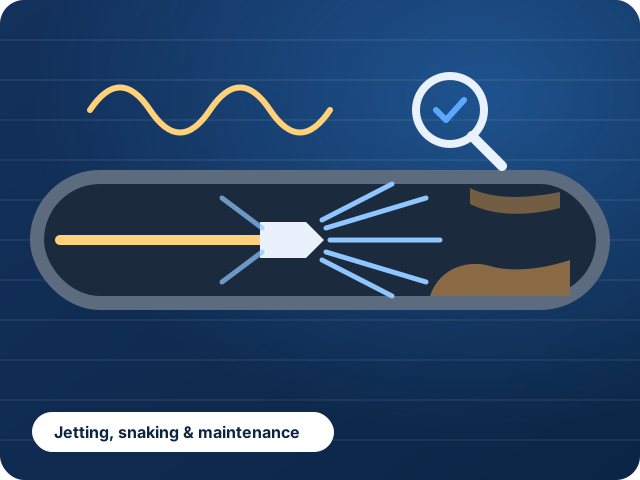
Snaking is fast at restoring flow and gentle enough for most fixture drains. Its limitation is that the cutting head is smaller than the pipe, so it can open a channel through grease or roots while leaving buildup on the walls. When a drain clogs again soon after snaking, that leftover buildup is often the reason.
Hydro jetting cleans the full diameter of the pipe and is better suited to heavy grease, sludge and fine roots. It is not needed for every clog, and we recommend it only when the line calls for it.
Before you try a store-bought snake
A plastic drain strip or a small hand auger can clear hair near the top of a bathroom drain. Beyond that, a few cautions:
- Forcing a cable through a toilet without a protective sleeve can scratch or crack the porcelain.
- A cable that kinks or binds inside a wall can be difficult to remove.
- If several drains are backing up, the clog is likely in the main line, which needs a larger machine and an accessible cleanout.
- If you have already poured a drain opener down the line, tell us before any cable goes in, since it can splash back.
Drain Snaking & Auger Service in Long Beach, step by step
- 1
Locate the clog
We ask which drains are affected to work out whether the blockage is in a fixture, a branch line or the main.
- 2
Choose the right cable
We pick a cable size, head and access point that suit the pipe and protect the fixture.
- 3
Clear and retrieve
The cable breaks up or hooks the blockage, and we examine what comes back to understand the cause.
- 4
Test the drain
We run water to confirm the drain flows normally and tell you if a camera or jetting is worth considering.
Tight access in Belmont Heights and Bluff Park
Homes in Belmont Heights and Bluff Park often sit close together, with narrow side yards, alley garages and cleanouts tucked behind fences, under decks or in planting beds. Snaking equipment is compact enough for most of these spots, but it helps to tell us where the cleanout is, whether there is a gate code, and whether we will be working from the alley.
Some older homes have no outside cleanout at all. In that case a main line can sometimes be reached by pulling a toilet or through a roof vent, which takes more time. A plumber can add an exterior cleanout, which makes future drain service simpler.